Today it is nicknamed "Sin City" or "City without Clocks" because of the abundance of casinos without windows or clocks, so that its players lose track of time. However, the name Las Vegas comes from the Spanish "vega", "valley, fertile plain". Two centuries ago, this metropolis of almost three million inhabitants in 2022 was nothing more than an expanse in the middle of the Mojave Desert and the mountains of southern Nevada. So how did Las Vegas go from a desert steppe to the city of excess in theAmerican West as it is now known?
An almost uninhabited desert of the American West
At the beginning of the 19th century, the mountains of Nevada officially had the status of Spanish territory. The population was very small and only the Païutes, the Amerindian tribes of the American West, lived there. However, the plain became more frequented with the creation of theOld Spanish Trail: in 1829, a caravan of sixty men was sent across the plains to establish a trade route between Santa Fe (New Mexico) and Los Angeles (California). On the way, one of its scouts, Raphael Rivera, discovered underground water holes, which were henceforth indicated on maps of the time for merchants and travellers under one name: Las Vegas.
However, it was not until 1944 that an official camp was set up there, thanks in particular to the popularisation of the area with the conquest of the West. The installation of Mormon missionaries who came in 1848 to evangelise the native communities, four years after the return of the territory to American hands, led to the installation of a fort. The first official building in Las Vegas, it is still standing. Although it became a place to stop on the road, it was quickly abandoned due to the lack of crops and the revolt of the Païutes. In the middle of the Utah War (1857-1858), which pitted these famous Mormons against the federal government, the place was taken over by the latter and renamed Fort Baker.
⋙ "Black Far West", a documentary that brings out the place of African-Americans in the conquest of the West
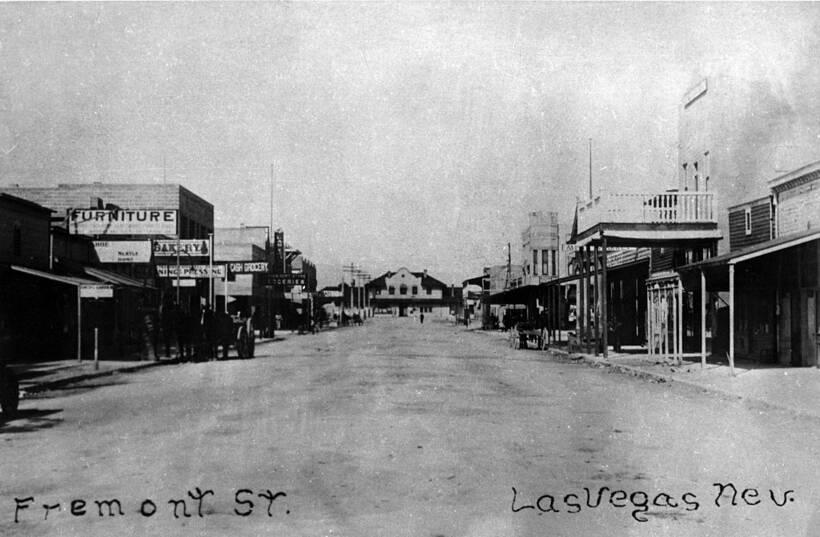
Fort Baker thus became a must-see stop in the Mojave Desert. Canalisation systems now made it possible to irrigate its arid lands. But it was above all the construction of a railway line between Albuquerque and Los Angeles by the entrepreneur William A. Clarke that marked the beginning of the city's development in the early 19th century. Las Vegas was an essential station, as it was right in the middle and had enough water to load the steam locomotives. The city was officially born on 15 May 1905. It was a typical western town with saloons and hotels, including the Hotel Nevada, now the Golden Gate Hotel and Casino.
Beginnings of the "sin city", run by mafia organisations
The history of Las Vegas was again marked in 1931 by the construction of the Hoover Dam fifty kilometres away on the Colorado River. The workers were settled in Boulder City, where alcohol and gambling were prohibited. Nevada was the first state to legalise gambling. Prostitution and divorce were also allowed. On weekends, the dam staff came to enjoy the vices of Fraymond Street, the first street in the city to be paved. A new population developed, mainly made up of men far from their families. This led to a boom in entertainment activities, which soon fell into the hands of unsavoury people.
At the same time, tourists flocked to see the progress of the construction of the dam, which was a feat at the time. Once the construction was completed in 1935, the flow did not diminish, on the contrary. Thanks to its production, electricity became inexpensive and Freymond Street was decorated with neon lights. New hotels and clubs were built, even more chic and luxurious, on the theme of the conquest of the West. The installation of military camps near the city from 1941, in the context of the Second World War, contributed to its development. To avoid paying taxes, entrepreneurs began to build outside Las Vegas, on what would become the Las Vegas Strip.

But while it was then only famous in the region, the potential of Las Vegas reached the ears of mafia organisations, including one of its members, Bugsy Siegel. After playing bootlegger during Prohibition, he moved to the Nevada city in 1945, where he developed and managed some of the Strip's first casinos. In particular, he financed the elegant Hotel Casino, which was geared more towards the glamour of Hollywood. The most feared criminal of those times, he was finally murdered in Beverly Hills (Los Angeles) in 1947. By this time, however, more than half of the casinos were controlled by or cooperating with the Mafia, who laundered their money there.
⋙ Exceptional drought exposes Las Vegas' murky underworld past
Las Vegas, city of all entertainments
The Stardust, the Riviera... Casino hotels are springing up, partly financed by the mafia. And in times of the Cold War, a new asset was added to the Las Vegas boot: on January 27, 1951, the first atomic test was held in the Nevada desert, just a few kilometres away. The consequences for health and the environment were unknown at the time, and tourists flocked to see the mushrooms, which could be seen from the city. Thenuclear weapon is on everyone's lips, and the business around it is fruitful: parties, rooftops, cocktails are developed on this theme. Miss Atomic elections are even organised, combining two "attractions", nuclear bombs and showgirls.
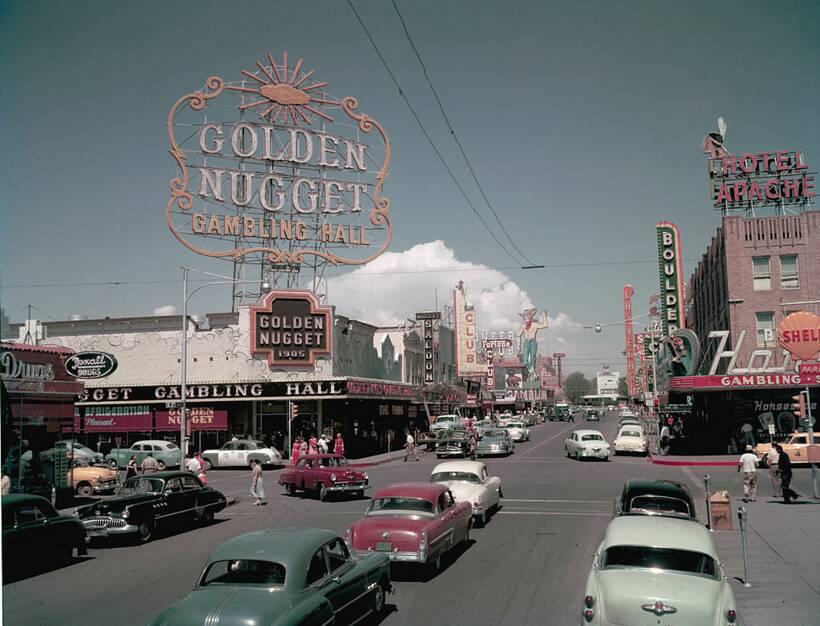
Fifty years after its official creation, Las Vegas has grown to 45,000 inhabitants and welcomes millions of visitors every year. Not only is the entertainment here like nowhere else (and at an affordable price), but America's biggest stars are beginning to be paid to flock here. Frank Sinatra, Louis Prima, Dean Martin could be heard in smaller, more intimate venues. From 1969 onwards, Elvis Presley performed at theInternational Hotel - two a night, seven days a week, for a total of 636 shows, according to the Los Angeles Times. Even today, his look-alikes continue to perform the lucrative express wedding business in the city.
"The bright lights light up my soul / Light up my soul in flames / I've got a bunch of money ready to go up in smoke / So these stakes rise higher / There's a thousand pretty girls waiting here / And they're all evil, better watch out / And I'm just the devil with love to borrow / Long live Las Vegas, long live Las Vegas" - Elvis Presley in "Viva Las Vegas" (1964).
The year 1966 saw the opening of Caesars Palace, then the largest hotel-casino in the world. In the same year, entrepreneur Howard Hughes - one of the richest and most powerful men in the country, close to the Mormons - moved to Vegas. He first bought the Desert Inn from a Detroit mobster for $13 million, then invested a total of $300 billion in the whole city... until he ended up pocketing almost a third of his income. By gradually replacing the mafia members behind most of the establishments, he helped make the place a more family-friendly destination. At the same time, the FBI is stepping up investigations to bring down these underworld heads.
⋙ These celebrities who have been under surveillance by the FBI
From mafia casinos to larger, still luxurious hotels
In the 1980s, they also started robbing people to make more money. The Hole in the Wall Gang, a group of burglars, was set up by an Italian-American mobster, Anthony Spilotro. To catch them, the feds and the local police take advantage of the change in the corrupt sheriff to cooperate. Bugs are planted in the casinos. Through an informant, the authorities learn of the organisation of a jewellery heist on the 4th of July 1981. On the day of the robbery, the participants are surrounded. Members testify against the gang in exchange for protection, investigations are launched to prove that money is being diverted from the casinos to Chicago.
The decade was marked by arrests, deaths and conversions of mobsters. The Mob Museum (National Museum of Organized Crime and Law Enforcement), in the city's old courthouse two blocks from the famous Fremont Street, has since been tracing the history of organized crime in the United States. Former mobster lawyer Oscar Goodman, of Anthony Spilotro and others, ended up as the city's mayor in 1999. He even played himself in Scorsese's film Casino. The 1990s finally marked the beginning of a new era. On the Strip, casinos with a dubious past were torn down and replaced by new, even more grandiose types of hotels.

They are called Mega Resorts, and offer equally lavish entertainment. The New York New York, the Bellagio, The Venetian, the Paris... the list of these prestigious casino hotels is growing. Every year, the largest new establishment of its kind is built in Las Vegas, a record that is always surpassed by another the following year. With a population of about 700,000 in the early 1990s, the city had nearly three million people thirty years later. It is said to be one of the fastest-growing regions in the United States, according to estimates by the U.S. Census Bureau.
While the place is still known for partying and is dubbed the"Disneyland for adults", the destination has also become more family-friendly over the years. For good reason, Las Vegas has all the makings of a city-sized amusement park for young and old. There are plenty of activities, restaurants, shows (and last-minute weddings) and affordable prices. On the condition, perhaps, that you don't splurge on casinos and slot machines, which are sometimes found right in the toilets - it hasn't remained the city of excess for nothing.